HYROX Stations Explained
Understanding each HYROX Exercise Station
On paper at least, HYROX appears simple: you run 1 km, then you complete a workout station, and you repeat that eight times. If you are completely new to the gym and even exercise however, the 8 stations themselves can seem overwhelming in terms of the specific movements and fitness required to complete them efficiently. The technique involved with each of the 8 stations, and the strategies athletes use to tackle each of them, can seem quite confusing, especially if you have never done the specific exercises before.
The good news is, that once you have an explanation and a demonstration, and a few goes yourself of each exercise, the whole circuit feels a bit more manageable. It can help to remember that learning new movements - which are effectively new skills, is one of the most rewarding things that you can do. Add to that the sense of community, and the objective way HYROX allows you to track your progression - and you definitely won't regret getting involved.
What is HYROX - A Quick Overview?
For a more comprehensive run down of HYROX, what it is, and how to train for it, please see our beginners HYROX guide here.
HYROX is a standardised fitness race built around 8 km of running broken into eight 1 km segments. Between each 1km run, is one exercise station. The race layout and station order are the same worldwide. This is great because it allows people to monitor their progression and compete with people across the world.
Across the event you’ll complete eight distinct stations: SkiErg, Sled Push, Sled Pull, Burpee Broad Jumps, Row, Farmer’s Carry, Sandbag Lunges and finally Wall Balls. You alternate between sustained running and short, sharp doses of strength, power exercises at the exercise stations.
The SAID Principle
The best way to train and build efficient technique for HYROX, is to actually do HYROX exercises. The SAID (Specific Adaptations to Imposed Demands) dictates that the body including the nervous system, adapts very specifically to the demands place on it. So you cannot expect to perform well on the Ski-erg, if you haven't trained using one.
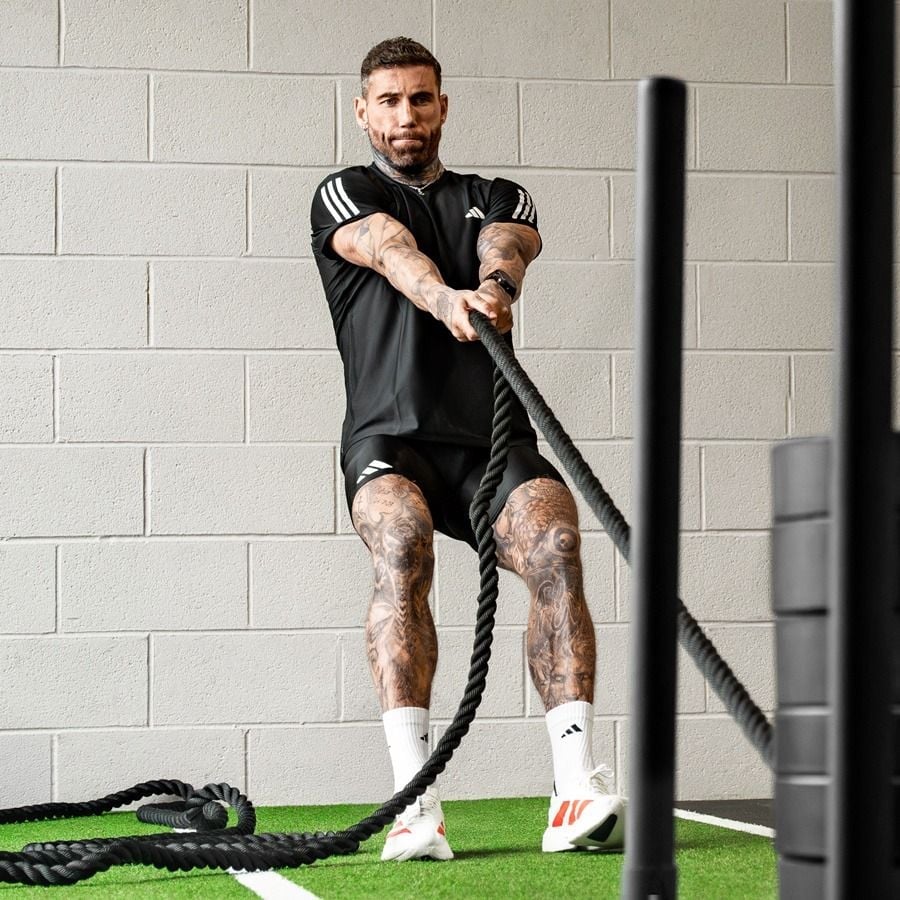
If you are training HYROX at home at all, then see our range of FORZA HYROX weights sets, including sleds, kettlebells and weighted bags. We also supply rowing machines and ski machines to gym and homes across the UK. Even short sessions carried out at home, on the specific equipment will build familiarity with the movements and optimal technique, and help your body adapt to the exact demands of race day. When training at home, or at any gym, it can also help to get technique feedback from a HYROX coach. Even if you don't have access to a HYROX gym, it can help to video yourself to make amends on your own observations, and/or you can share it with friends, or online communities for tips and feedback. You can use simple editing software to 'hide' your face if required before sharing.
HYROX Station 1: SkiErg (1000 m)
Ski Erg
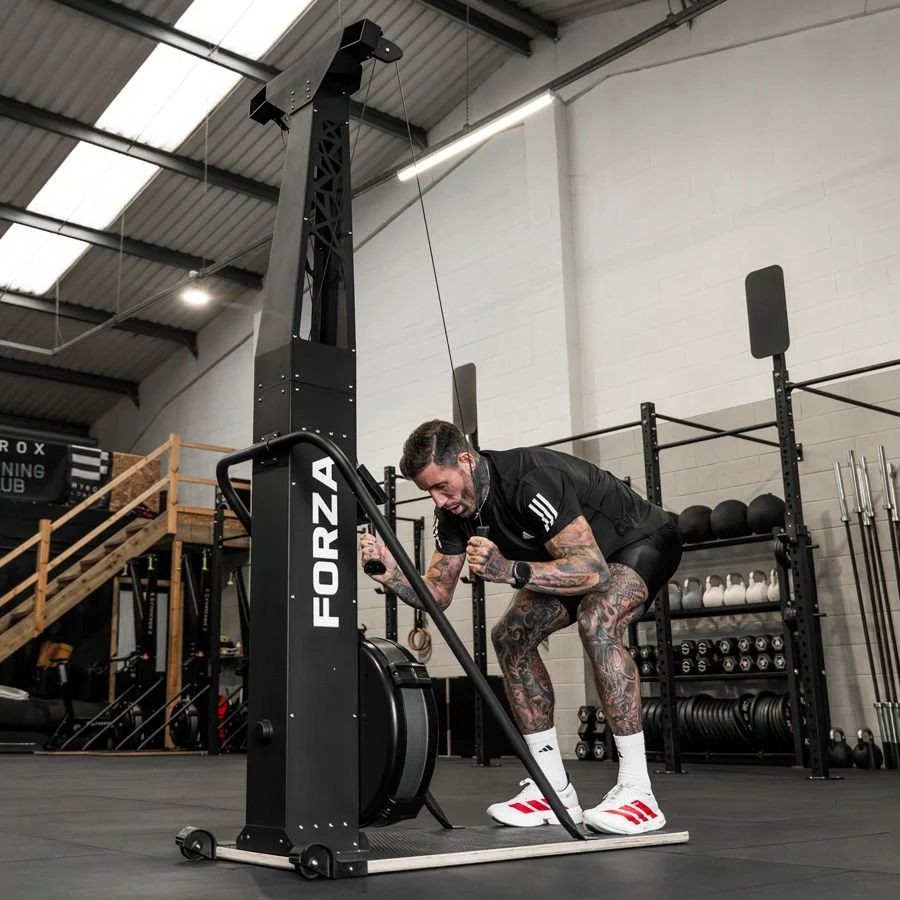
You ski 1000m on a SkiErg, simulating cross-country skiing using a specific machine with two handles that attach to cables/ropes that you pull downwards. This replicates the arm movement when skiers use sticks to drive off from the ground. In the current format at the time of writing, the SkiErg is often the first station after the opening run. In any order it remains a significant upper-body and core challenge.
Physiological challenge
The SkiErg emphasises upper-body pulling strength, lats, triceps and core, while still involving a partial hip hinge and leg drive.
It terms of cardiovascular effort, it sits in the "hard but sustainable" zone for many athletes. It's a steady but usually manageable exercise, especially if you can resist the temptation to sprint the first 300m. It's still an incredible challenge for beginners, and there's always the goal of recording a personal best and/or competing with others across the world.
Training tips
- Start with intervals on the SkiErg (for example, 5 × 250 m) to learn what sustainable pacing and correct technique feels like.
- Strengthen lats, triceps and shoulders with pulldowns, straight-arm pulldowns and overhead work. High repetition sets are preferable.
- Technique can be tricky to start. As with other stations ask a coach for feedback or video yourself and watch it back before embarking on another set.
Whilst building a base of cardiovascular fitness, strength, power and muscular endurance, will always provide a good foundation, to reach your full potential at a given sport or exercise, you should do that sport or exercise (as outlined in SAID principle above). In this article, the training tips will contain an array of exercises, but the core of your training for a given station, should be the specific gym exercise that is done on the station you want to get better at - in terms of your time and technique.
Race-day tips
- Keep the core tight and think of driving the handles down from a stable back, not from a collapsing spine.
- Use a smooth, cyclical rhythm instead of jerky pulls; let the handles rise back up under control.
- People tend to accelerate as they pull downwards, starting off relaxed at the top/start of the arm movement.
HYROX Station 2: Sled Push
Sled Push Explained
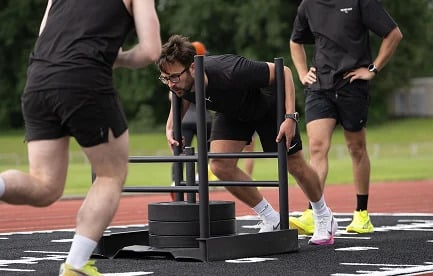
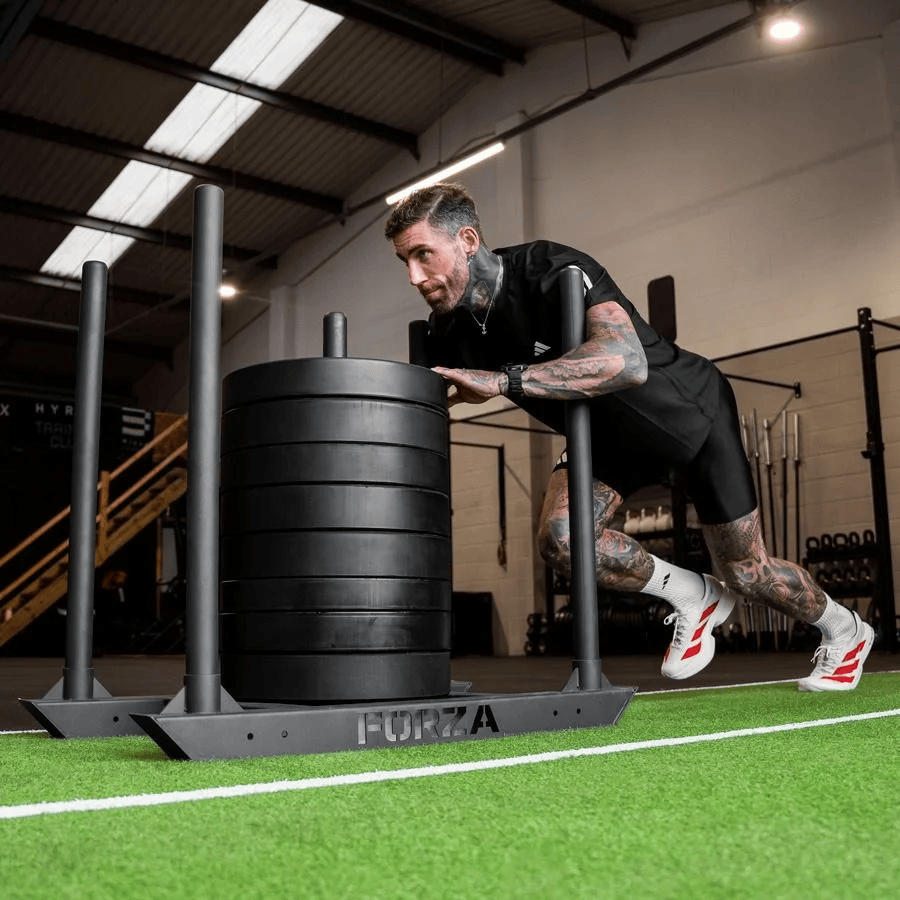
You drive a heavy sled over 50 m total, usually set up as 4 × 12.5 m or 2 × 25 m depending on venue. Official race loads (including the sled itself) are much heavier than most gym programming: in Open divisions you often see around 102 kg for women and 152 kg for men, with Pro categories going up to 152 kg (women) and 202 kg (men). That’s the kind of load feels impossible for many people...but with consistent training, most people can develop a level of fitness to complete 50m with it.
Fitness challenge
The sled push is a brutal test of leg strength, local muscular endurance and the ability to brace your core (the muscles around the spine and abdomen that keep your torso stable). Your quads, glutes and calves are doing most of the visible work, but your shoulders and upper back are quietly suffering to keep the torso angle consistent. For a lot of people, this is also where you first notice how much your lungs are working extremely hard, and catching up from the previous run, not just from the sled push itself.
Training tips
Use heavy sled or prowler pushes in training, occasionally above race weight for short distances to build confidence.
Strengthen legs with squats, split squats and lunges for powerful glutes to begin the drive with the sled.
Build core stability with planks and anti-rotation work (for example, Pallof presses) to prevent your hips twisting under load.
A useful cue is to keep your torso low, arms straight, and drive with short, choppy steps, almost like you’re trying not to slip on a slightly dusty gym floor. If your heels keep slamming down, you’re too upright - is something to keep in mind. It is a bit simplistic way to think of the posture, but it seems to help.
Race-day tips
- Start steady rather than maximal; pace yourself or you'll likely make the rest of the race feel very long.
- Keep your hands low on the sled, lock the elbows, and lean your bodyweight into it so your legs can do the pushing.
- If the sled feels glued to the floor, try very small steps and focus on breathing out through pursed lips to stay calm.
HYROX Station 3: Sled Pull
Sled Pull Explained
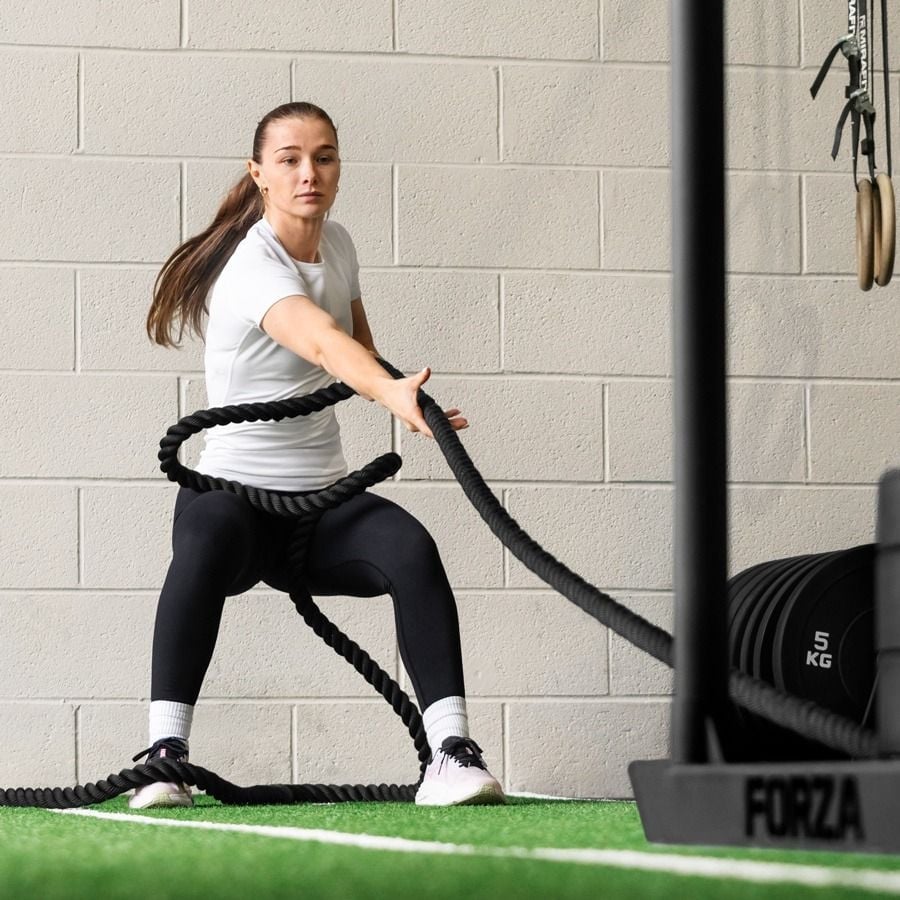
You pull the same sled 50 m using a thick rope. The distance is usually in 4 × 12.5 m lengths. The weights on the sled are slightly lighter than the push: Open women use 78 kg, Open men 103 kg, with higher weights for Pro and some team formats.
Fitness challenge
Here the emphasis shifts more towards upper-back strength, grip endurance and coordinated leg drives and hip extension. Your lats (large muscles on the side of the back), biceps, forearms and posterior chain (group of muscles on the posterior of the body) all work together to move the sled.
Your core muscles keep your body steady, so you can anchor yourself in place. Trainers or sports shoes with a good firm grip will help you quite a bit when performing the pulls.
It is often the forearms and grip that fatigue the most, and is often the limiting factor in terms of performance and times. It's a great exercise for building muscular endurance in the arms and upper back, and strengthening the core.
Training tips
- Practice rope pulls seated and standing, with a heavy sled or anchored cable.
- Build upper-back strength with dumbbell rows and pull-ups.
- Squats and step-ups can be used to develop a more powerful leg drive.
- Lower body plyometrics like depth jumps or repeated vertical jumps develop explosive power*
- Build up lots of time actually doing the sled pull at the gym.
It helps to sit your hips low, brace, then "pull" hand-over-hand while you walk or shuffle backwards.
*Plyometrics are excellent for developing power and speed. Just be sure to get advice on your technique and preparedness, as they are high-impact and can be hard on the joints, lower back etc.
Race-day tips
- Keep your core tight and shoulders engaged so the force goes into the sled, with no energy wasted trying to maintain your balance.
- Use your legs to push the floor away as you pull, instead of trying to curl the entire sled with your arms.
- Avoid jerky, all-or-nothing pulls; continuous, rhythmic tension keeps the sled moving and your breathing more controlled.
HYROX Station 4: Burpee Broad Jumps
Burpee Broad Jumps Explained?
You perform burpee broad jumps over a total distance is 80 m in current formats. Each rep is a full burpee: chest to floor - followed by a horizontal jump forward.
Fitness Challenge
The exercise that people love to hate, or just hate. Burpee broad jumps combine a push-up pattern, a jump and a transition to standing. They challenge endurance, explosive power and coordination.
Cardiovascularly, it’s a strong stimulus to your heart & lungs because you keep changing body position - down to the floor, up to standing, then jumping - which makes the heart and lungs work hard to keep meet the demands of the exercise.
In a single burpee, your body travels from a standing position to chest-on-the-floor and back up again. Moving your entire body weight across that vertical distance requires a massive amount of effort.
You are fighting gravity on the way down and overcoming it on the way up. Burpees also tax the entire lower and upper body - meaning the heart has to work hard to provide blood to all the working muscles.

As well as working a range of muscles, burpees challenge different elements of fitness - it is ultimately an endurance exercise when done for multiple reps, but the jump itself is a power exercise.
This means that the body has to recruit different physiological systems and muscle types. For example "Type 1 - Slow Twitch" muscle fibres, that have adapted to endurance are used, but also "Type 2 - Fast Twitch" muscle fibres are required for the jumping phase.
Training Tips
- Use intervals of burpee broad jumps (for example, 20–30 seconds on, 30–40 seconds off) to accustom yourself to repeated efforts and the specific demands.
- Include plyometrics - Advanced athletes may look to include box jumps, jump squats - to improve jump distance and landing mechanics.
- Weighted burpees - some advanced athletes will also work with light dumbbells, and/or a weighted vest to additional fitness when progress plateaus.
Land softly, with knees slightly bent, and think about absorbing impact rather than slamming into the floor like tired planks. Many HYROX Reddit race reports mention this station as the mental low point, so be prepared to push through the mental fatigue and get a second wind.
Race-day tips
- Shorten the jump slightly rather than going maximal; consistent medium jumps usually beat inconsistent big ones.
- Keep your feet roughly hip-width to protect knees and prevent awkward twists.
- Use your arms aggressively on the jump forward, then let them help “catch” you on the landing for stability.
HYROX Station 5: Rowing (1000 m)
Rowing Station Explained
You row 1000 m on a gym rowing machine.
Fitness challenge
Rowing is a full-body endurance exercise, taxing legs, back muscles and cardiovascular fitness. Good technique can make a huge difference.
Done correctly, the majority of power comes from the legs, with the hips and back following, and the arms finishing the stroke in a smooth sequence. Beginners and those under fatigue often start "arm-rowing" which is much less efficient and usually much more tiring.
Training tips
- Practice the basic stroke sequence:
To begin:
Drive with legs → extend hips → pull with arms.
On the recovery phase/retun to start:
Extend arms → bend hips → bend legs
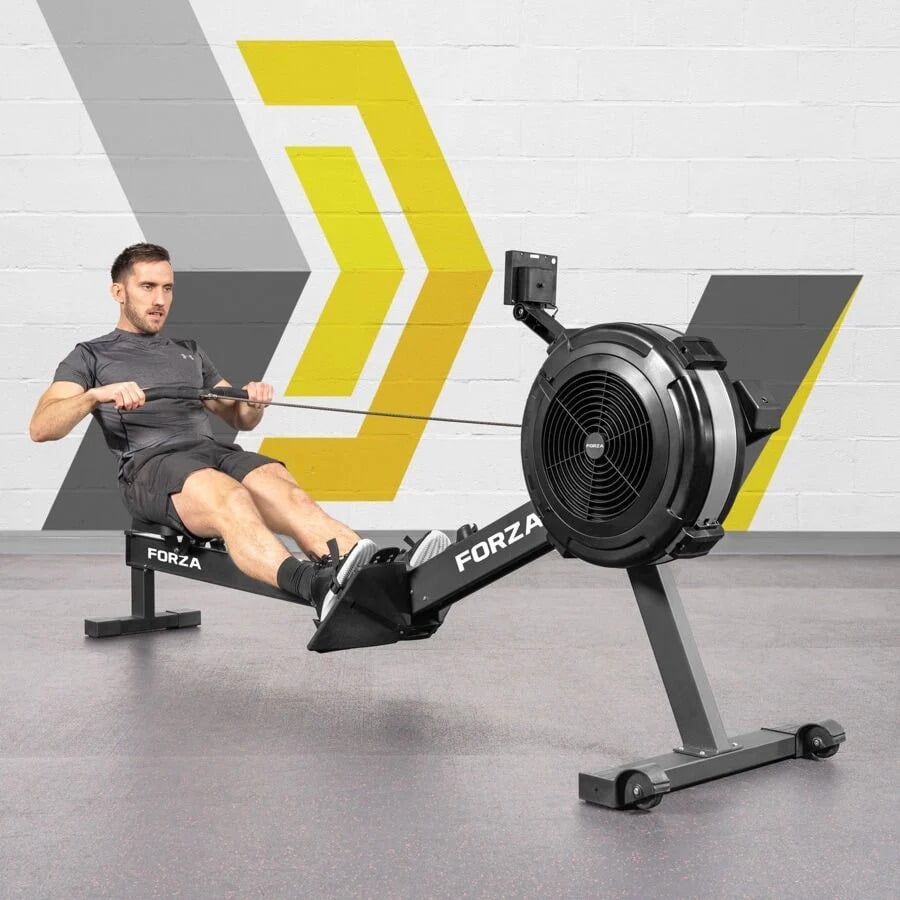
The main mistake beginners often make is pulling and bending their arms right at the start. Keep your arms out straight and drive with your legs first.
There is a "catch" phase, between the end of the leg and hip drive, and pulling on the handle. The arms should remain relatively straight up until this point.
- Use interval work (for example, 4 × 500 m) and tempo rows (1000–1500 m at moderate pace) to build both speed and pacing awareness.
- Strengthen posterior chain (glutes, hamstrings, lower back) so that each drive feels solid rather than fragile.
HYROX coaches recommend a relaxed but consistent rhythm rather than frantic strokes; think "powerful push, smooth glide," even if your heart rate says otherwise.
Race-day tips
- Start the first 200–300 m a touch under your training 1 km pace so you don't redline too early.
- Keep the stroke rate moderate (often 24–28 strokes per minute for many athletes) and focus on power per stroke, not frantic speed.
- Sit tall on the seat, avoid over-reaching with the lower back, and exhale on the drive to keep tension manageable.
HYROX Station 6: Kettlebell Farmer's Carry
Farmer's Walk/Carry Explained
You carry two kettlebells 32 kg per hand for men and 24 kg per hand for womenfor a distance of 200 m.
The 200m is normally split into 4 x 50m lanes.
Fitness challenge
Farmer's carries really challenge your grip, forearms, shoulders and core. It demands that you stabilise your trunk while walking under load. They also challenge your postural endurance, meaning your ability to keep your upper body upright and aligned even when a load is pulling you forwards or backwards.
Training tips
- Include regular farmer's walks with kettlebells or heavy dumbbells, starting with shorter distances and progressing towards 200 m or more.
- Use dead hangs, towel hangs or grip trainers to build hand and finger strength.
- March on the spot if you train somewhere without lanes or limited space.
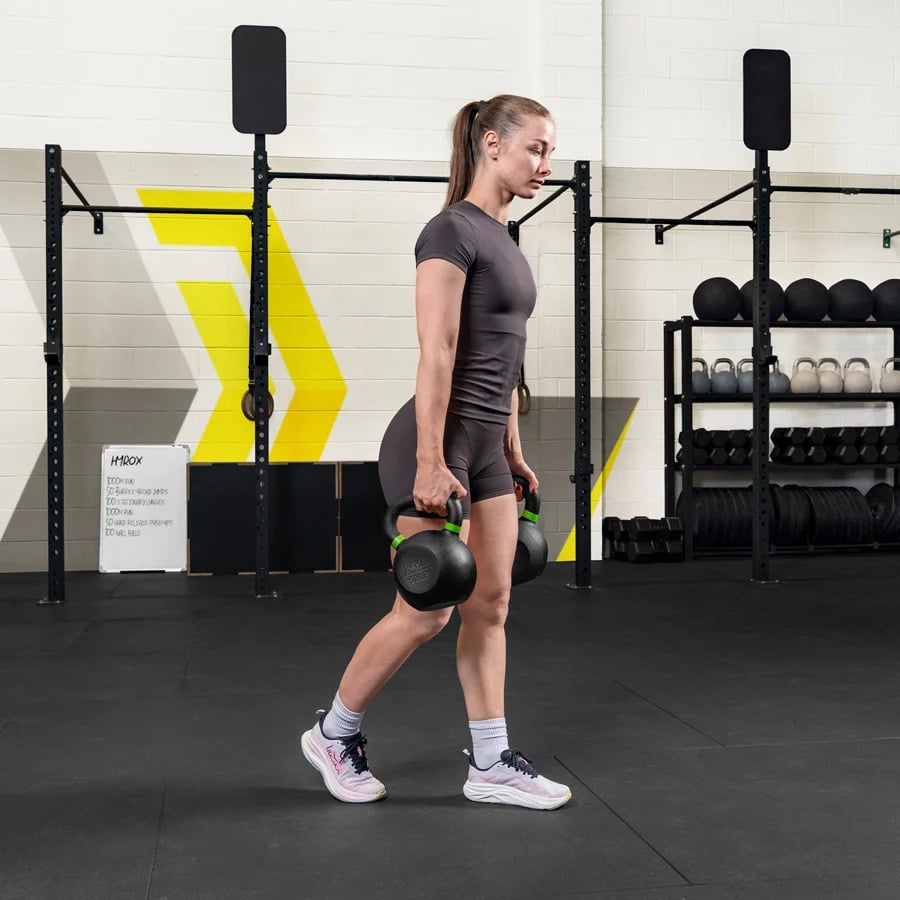
- Strengthen core with carries in different positions (rack carry, suitcase carry) to become more resilient to sway.
- It's common to see someone set the kettlebells down, shake out their hands, then pick them up again.
Race-day tips
- Keep shoulders back, ribs down and eyes forward, like you're walking with purpose rather than shuffling.
- Take calm, measured steps; rushing often increases sway and wastes energy.
- If you need to drop the kettlebells, do it in planned intervals (for example, every 50 m) instead of waiting until your grip fails.
HYROX Station 7: Sandbag Lunges
Sandbag Lunges Explained
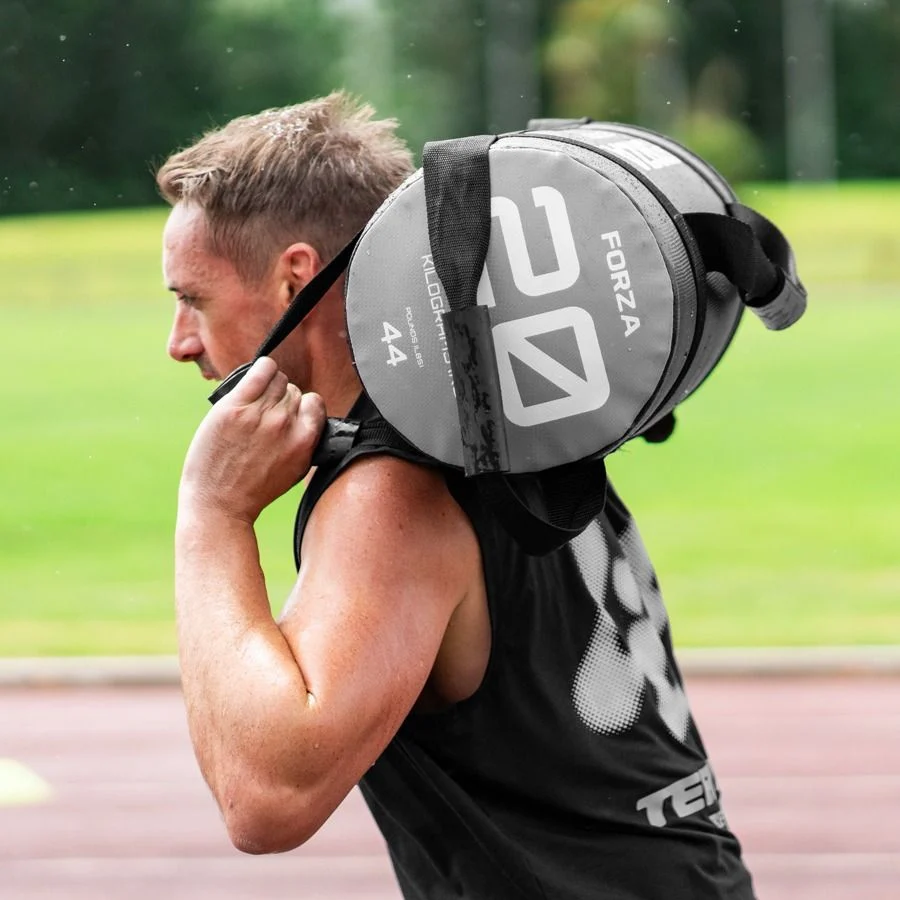
You perform 100 m of walking lunges while carrying a sandbag across your shoulders. The sandbags weigh 20 kg for men and 10 kg for women, except for the Pro-division with women using 20kg and men 30kg. The sandbag must stay on both shoulders and cannot be dropped during the working segments.
Fitness challenge
Sandbag lunges demand leg strength, balance and a strong, steady core while a shifting load tries challenges your balance. Your quads and glutes are doing continuous work, but your smaller stabilising muscles around the hips and ankles are also firing to keep each step controlled. As fatigue from earlier stations accumulates, balance and lower body muscular endurance are challenged.
Training tips
- Use walking lunges with dumbbells, barbells or sandbags, gradually extending the distance toward 50-100 m sets.
- Train balance with single-leg RDLs, step-ups and static holds, so wobbling doesn't become your default pattern.
- Unstable surface training on wobble cushions can also help with balance

- Add rotational core work (like Russian twists or cable chops) to handle the sandbag's tendency to sway.
Lunges can cause a lot of muscle soreness the next day or two. Delayed Onset of Muscle Soreness (DOMs) can be a really issue for the first few weeks of HYROX training. You can improve recovery with a foam roller and an ice bath routine. This is another reason to focus on technique during your first few visits to the HYROX gym - rather than pushing your fitness to the limit.
Race-day tips
- Keep your torso upright and eyes fixed ahead.
- Take reasonably long but controlled steps so that the back knee can gently touch the floor each time (as required by the rules).
- Use your hands to steady the sandbag on both shoulders and adjust it quickly if it starts to slide.
HYROX Station 8: Wall Balls
Wall Balls Explained
You complete 100 wall balls, throwing a 6 kg ball for men, 4 kg for women in Open divisions, to a target. The target is usually 3 m high for men and slightly lower for women. Each rep is a full squat followed by an upward throw. Then you catch and repeat 99 times.
Fitness Challenge
Wall balls are a combined strength and conditioning effort. Recruiting legs, glutes, shoulders and triceps while your heart rate climbs. The movement is essentially a front-loaded squat into a powerful overhead throw. Leg and shoulder endurance are the two common limiting factors, building up lactic acid and fatigue quickly. Again this will cause a lot of muscular soreness the following 48 hours after your first go.
Training tips
- To begin with pracice sets of 15-30 reps and have a short break. This avoids frustration and a build up of lactic acid affecting your accuracy.
- Improve leg strength with squats and jump squats so the squat portion feels efficient.
- Build shoulder and arm endurance with push-ups, overhead presses and dips.
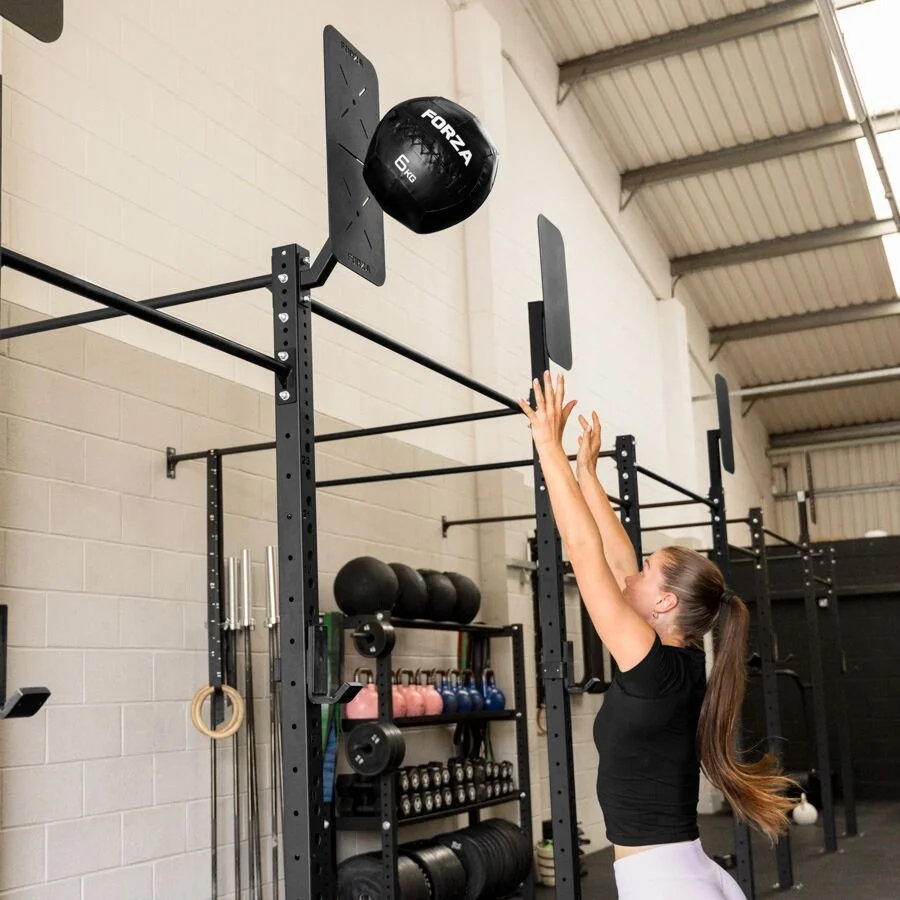
A small but useful detail: keep the ball close to your chest on the way down rather than letting it drop away from you, which saves your shoulders and stops that awkward fumble where the ball rolls off and lands on the floor. That kind of chaos is more common late in the race but can be an issue if you are looking for a good race time.
Race-day tips
- Choose manageable sets (for example, 10–15 reps) with very short rests instead of chasing huge unbroken sets that blow your heart rate up.
- Exhale as you drive out of the squat and release the ball, matching breath to movement.
- Hit full depth in the squat consistently to avoid no-reps, which are emotionally expensive this late in the race.
| HYROX Station Breakdown: Weights, Muscles and Estimated Calories | |||||
|---|---|---|---|---|---|
| Station | Distance / Reps | Open Weights (M / W) | Primary Focus | Main Muscles Used | Est. kcal |
| 1. SkiErg | 1000m | No external load | Upper-body endurance, pacing control | Lats, shoulders, triceps, core | 80-120 kcal |
| 2. Sled Push | 50m (4 x 12.5m) | Men 152kg / Women 102kg | Leg power, strength endurance | Quads, glutes, calves, core | 40-65 kcal |
| 3. Sled Pull | 50m (4 x 12.5m) | Men 103kg / Women 78kg | Upper-back strength, grip, leg drive | Lats, biceps, forearms, posterior chain | 35-55 kcal |
| 4. Burpee Broad Jumps | 80m | Bodyweight | Explosive power, coordination | Full body (chest, shoulders, legs, core) | 65-100 kcal |
| 5. Rowing | 1000m | No external load | Endurance, pacing, technique | Legs, back, arms, core | 70-110 kcal |
| 6. Farmers Carry | 200m | Men 2 x 24kg / Women 2 x 16kg | Grip, posture, core endurance | Forearms, shoulders, core, legs | 40-65 kcal |
| 7. Sandbag Lunges | 100m | Men 20kg / Women 10kg | Balance, leg strength, core control | Quads, glutes, hips, core | 55-90 kcal |
| 8. Wall Balls | Open 75 reps / Pro 100 reps | Men 6kg to 3.0m target / Women 4kg to 2.7m target | Power, muscular endurance, coordination | Legs, shoulders, triceps, core | 55-85 kcal |
| Stations Total | 8 stations | - | - | Full body | 440-690 kcal |
| Total with Runs | 8 stations + 8 x 1km runs (8km) | - | - | Full body | 840-1250 kcal |
Key Training Principles
- Run regularly: mix easy runs with 1 km repeats or short intervals to simulate race segments.
- Lift for strength: squats, deadlifts, presses and rows provide the general horsepower needed for sleds, carries and lunges.
- Use interval circuits that string together, say, a short run plus one or two stations to rehearse transitions and pacing.
- Keep some mobility work in the week. A yoga session or specific stretches of the hips, ankles, shoulders. This is important to reduce the risk of tightness turning into injury when fatigue sets in.
- Consider 1-set-weight training - to build strength with squats, presses etc, with limited negative impact on your recovery and HYROX-specific training.
- Consider investing in a foam roller, yoga mat and ice bath for recovery.
People who practised "race simulations" (for example, 3–4 rounds of 1 km run plus a station) generally report feeling less shocked on the day. Obviously you'll want to work up to the full running distance and 8 stations in a practice session at least once before race day. Just don't peak too soon, or do your full practice race a few days before. It can take a while to recover, and you are best to taper down before a competition. See our 12 week HYROX training programme for more information.
HYROX Stations FAQs
Before you embark on your HYROX journey, you will no doubt have many questions to ask. Below we've answered some of the most common HYROX station questions.
What are the 8 HYROX stations and race format?
HYROX consists of 8 x 1 km runs (total 8 km) alternating with 8 functional stations in fixed order:
SkiErg (1000m), Sled Push (50m), Sled Pull (50m), Burpee Broad Jumps (~80m), Rowing (1000m), Farmer's Carry (200m), Sandbag Lunges (100m), Wall Balls (100 reps).
Each run is exactly 1 km between stations.
What are the standard weights and distances for each HYROX station?
- Sled Push/Pull: 50m each. Open: Women - 102kg push/78kg pull, Men - 152kg push/103kg pull (includes sled weight - 20-30kg empty)
- Burpee Broad Jumps: 80m total distance (number of jumps varies by athlete jump length)
- Rowing: 1000m fixed distance
- Farmer's Carry: 200m with kettlebells (Open: Women 24kg/hand, Men 32kg/hand)
- Sandbag Lunges: 100m (Open: Women 10kg, Men 20kg sandbag)
- Wall Balls: 100 reps (Open: Women 4kg to 2.8m target, Men 6kg to 3m target)
- SkiErg: 1000m fixed distance
How long does a HYROX race take and how long are individual stations?
Full HYROX races typically take 60-90 minutes for most athletes (elite ~50-60 mins, beginners 90+ mins). Station times vary widely:
sleds/carries ~2-5 mins, rowing/SkiErg ~4-6 mins, burpees/wall balls ~5-8 mins depending on fitness and pacing. Runs average 4-6 mins each.
Are there water stations, can you take gels, and what fueling is allowed during HYROX?
Yes, HYROX provides water stations after most exercise stations. Athletes can bring and consume gels, chews, or drinks during runs/transitions. Keep nutrition simple - most athletes use 1-2 gels + water and/or a sports drink.
How many reps/reps per station in HYROX (burpees, wall balls, lunges)?
- Burpee Broad Jumps: Distance-based (80m), so 25-40+ jumps depending on your jump length
- Wall Balls: Exactly 100 reps
- Sandbag Lunges: Exactly 100m (roughly 40-50 steps per leg depending on stride)
Can I get fit for HYROX with anything besides training with running and HYROX stations?
In order to perform optimally, over the course of a year, HYROX itself should be a significant element of your overall training. However, you may wish to add in, or for a certain period of time, replace some of the HYROX-specific training, with mobility and core work like yoga and Pilates. In addition, a scientific study that specifically looked at HYROX found that the race primarily taxes endurance capacity. The study concluded that VO2Max (maximum volume of oxygen your body can transport & utilise during intense exercise per minute), was the best predictor of performance and that any training that enhances VO2Max, would in theory help with HYROX performances.
Conversely, the study found that grip strength and muscle mass were not correlated with HYROX race times, suggesting that additional work in the gym should focus on endurance and VO2Max training, and not a huge amount of strength work. One possible compromise could be 1-set strength training, once or twice a week. As performing one "working" set, after a warm up, has been shown in some studies and populations to be just as effective as 3 sets, without the same soreness, recovery & overtraining issues. A 2024 study found that "training to failure in single-set routines may modestly enhance...measures of muscle hypertrophy and power".
Which HYROX station or exercise should I focus on to begin with?
During a HYROX race, participants tend to spend around 60% of their time running. Research carried out in 2024, found that athletes spent a median of 51.2 minutes running versus 32.8 minutes on exercise stations. With this in mind, if you were to focus on one element to begin with, running should arguably make up the majority of your training alongside learning efficient technique at each station. One thing to be aware of however, is that research carried out in 2010 on endurance athletes suggests that excessive running volume is a major risk factor for injury. With this in mind, consider building your VO2Max primarily through running, but also include lower-impact endurance training on gym machines like cross trainers, and the HYROX stations like the rowing machine and SkiErg. This will put less strain on the joints, still build endurance and VO2Max, whilst you get more proficient at the rowing and Ski-Erg stations.
What's the difference between a Wall Ball and a Medicine Ball?
Wall balls are often larger, soft, and designed for throwing against walls, whereas traditional medicine balls are smaller, denser, and used for controlled, rotational, or strengthening exercises. Wall balls are best for high-repetition, full-body power training, while med balls excel at slams, tosses, and core exercises.
What are the HYROX stations weights in lbs?
The table below shows all the HYROX weights in lbs:
| HYROX Station Weights in Lbs | ||||
|---|---|---|---|---|
| Station | Distance / Reps | Open Men (lbs) | Open Women (lbs) | Primary Muscles |
| 1. SkiErg | 1,094yds (1,000m) | Bodyweight | Bodyweight | Lats, shoulders, triceps, core |
| 2. Sled Push | 55yds (50m) — 4 x 13.7yds (12.5m) | 335 lbs (152kg) | 225 lbs (102kg) | Quads, glutes, calves, core |
| 3. Sled Pull | 55yds (50m) — 4 x 13.7yds (12.5m) | 227 lbs (103kg) | 172 lbs (78kg) | Lats, biceps, forearms, posterior chain |
| 4. Burpee Broad Jumps | 87.5yds (80m) | Bodyweight | Bodyweight | Full body |
| 5. Rowing | 1,094yds (1,000m) | Bodyweight | Bodyweight | Legs, back, arms, core |
| 6. Farmers Carry | 219yds (200m) | 2 x 53 lbs (2 x 24kg) | 2 x 35 lbs (2 x 16kg) | Forearms, shoulders, core, legs |
| 7. Sandbag Lunges | 109yds (100m) | 44 lbs (20kg) | 22 lbs (10kg) | Quads, glutes, hips, core |
| 8. Wall Balls | 75 reps (Open) / 100 reps (Pro) | 13 lbs to 10ft target (6kg / 3.0m) | 9 lbs to 9ft target (4kg / 2.7m) | Legs, shoulders, triceps, core |
| Total | 8 stations + 8 x 1,094yd runs (8,750yds / 8km) | Est. 840–1,250 kcal burned | Full body | |
HYROX - Getting Started
HYROX has its own culture and community. Once you get started and see progression, with all the support you'll likely have, it's easy to get hooked.
You've now got the blueprint for tackling each station. Every sled, every burpee, every wall ball - focus on technique to start and don't worry about your time.
Once you have built a strong foundation of HYROX-specific fitness, it can help to isolate your weakest stations, and spend a set amount of time focusing on improving your specific fitness and technique.
It can also help to identify what element of your weakest stations you find most difficult - for example, your grip might be your limiting factor for the sled pull. With this in mind, training grip specifically may help - speak to your coach or fellow athletes for some tailored advice.
If you are looking to train at home, be sure to check out our kettlebells, sleds, weighted-bags and gym machines. With a bit of improvisation, for example, marching on the spot with kettlebells if you don't have room to walk with them, you can get some highly effective additional training hours completed at home. If you want an in-depth guide on everything HYROX, see our beginners' HYROX guide here.
Train smart. Move well. Finish strong.
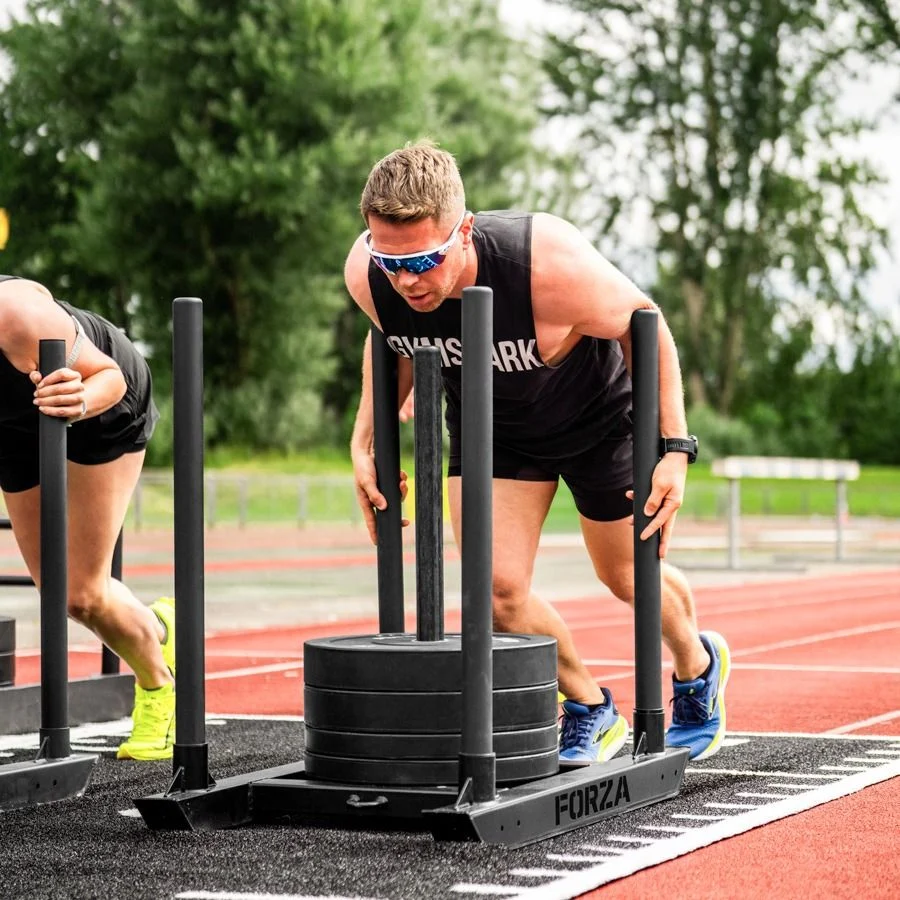

- 2 x Cast Iron Kettlebells [16kg or 24kg in Pro bundle]
- 1x Power Weight Bag [10kg or 20kg in Pro bundle]
- 1x Wall Ball [4kg or 6kg in Pro bundle]
- Precision-cast steel kettlebells
- Easy-to-clean PVC exterior sandbags
- Specially designed bundles for Hyrox-style training
- Effective for enhancing strength & fitness
- All equipment is marked with both metric and imperial units
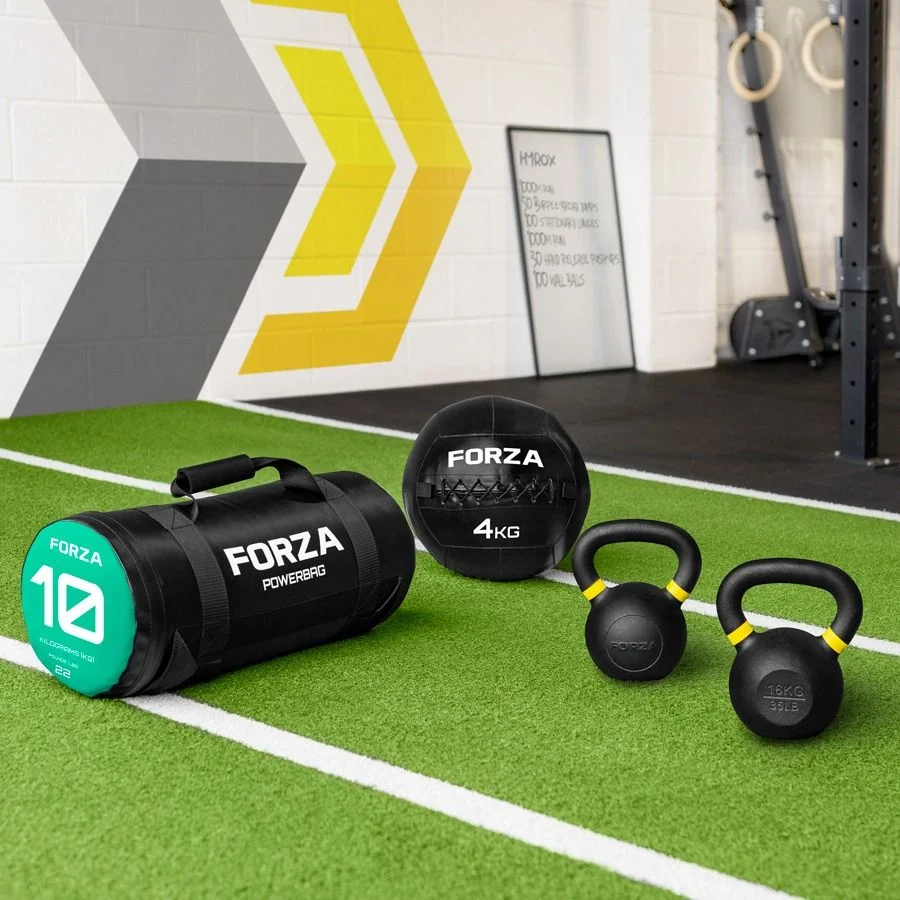
- 2 x Cast Iron Kettlebells [24kg]
- 1x Power Weight Bag [20kg]
- 1x Wall Ball [6kg]
- Precision-cast steel kettlebells
- Easy-to-clean PVC exterior sandbags
- Specially designed bundles for Hyrox-style training
- Effective for enhancing strength & fitness
- All equipment is marked with both metric and imperial units
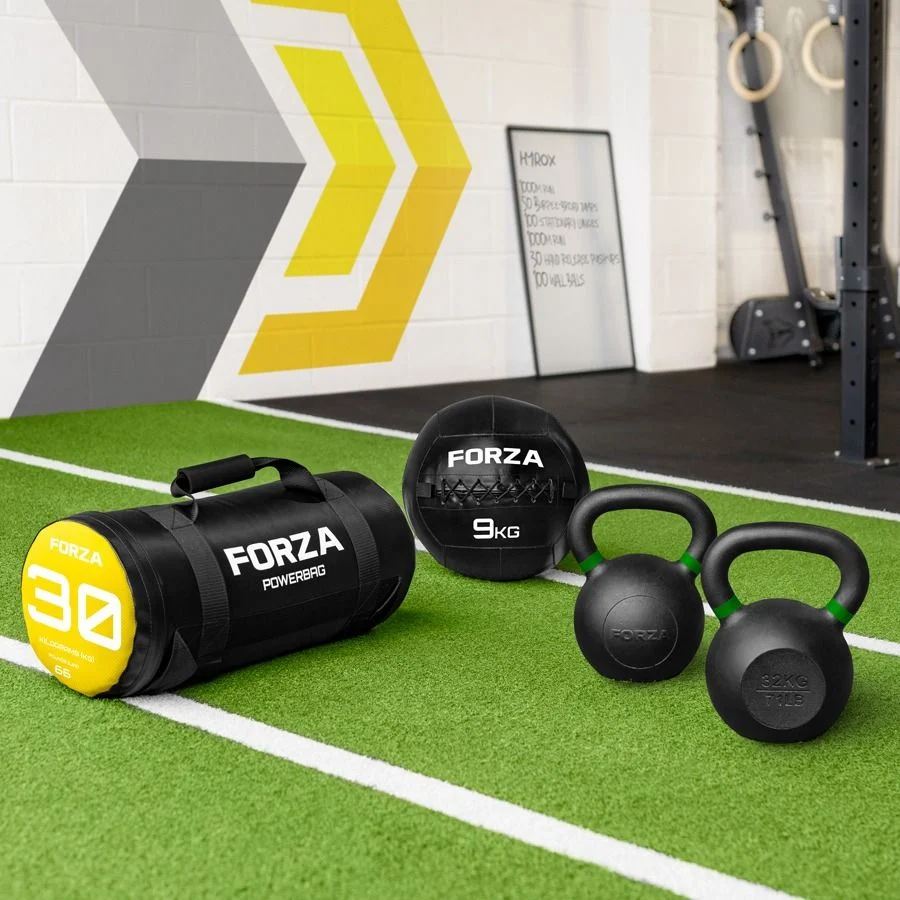
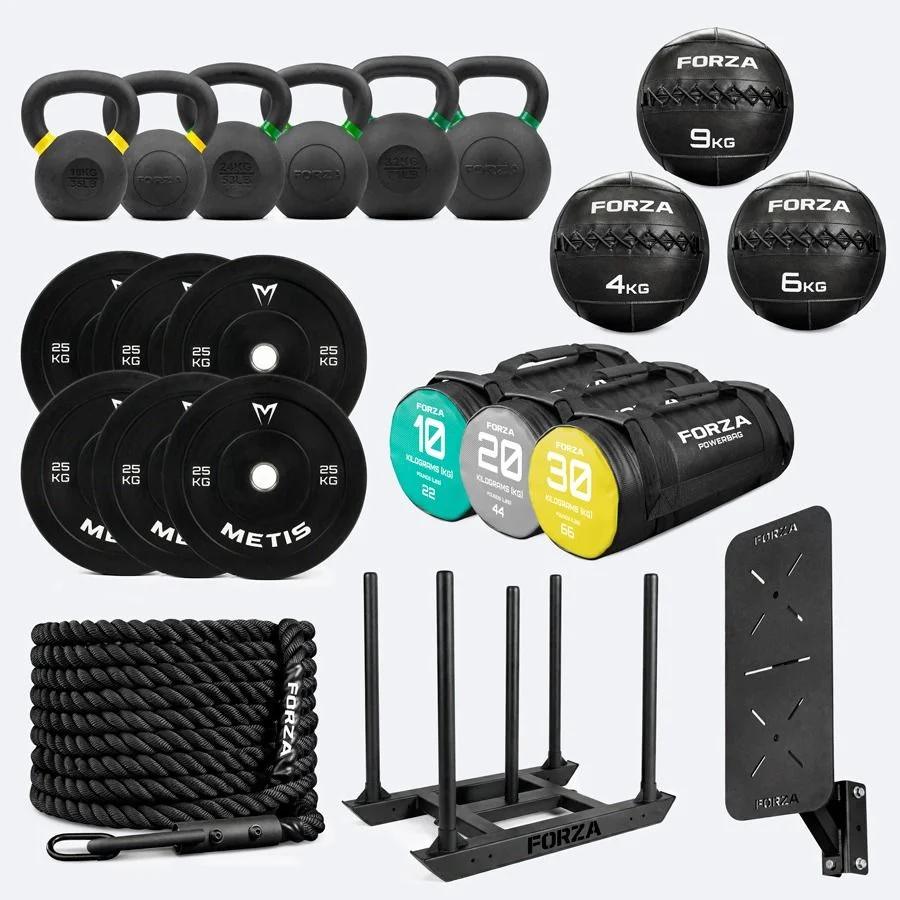
- FORZA Competition Weight Sled
- FORZA Double Wall Ball Target
- FORZA Sled Pull Rope
- FORZA Wall Balls [4kg, 6kg & 9kg]
- FORZA Cast Iron Kettlebells [16kg, 24kg & 32kg Pairs]
- FORZA Power Weight Bags [10kg, 20kg & 30kg]
- METIS Olympic Bumper Plates [Six 25kg Plates]